Micro motors · vibration modules
A few hundredths of a millimetre off-centre, and a vibration motor hums instead of buzzes. The eccentricity is not an appearance feature; it is the function.
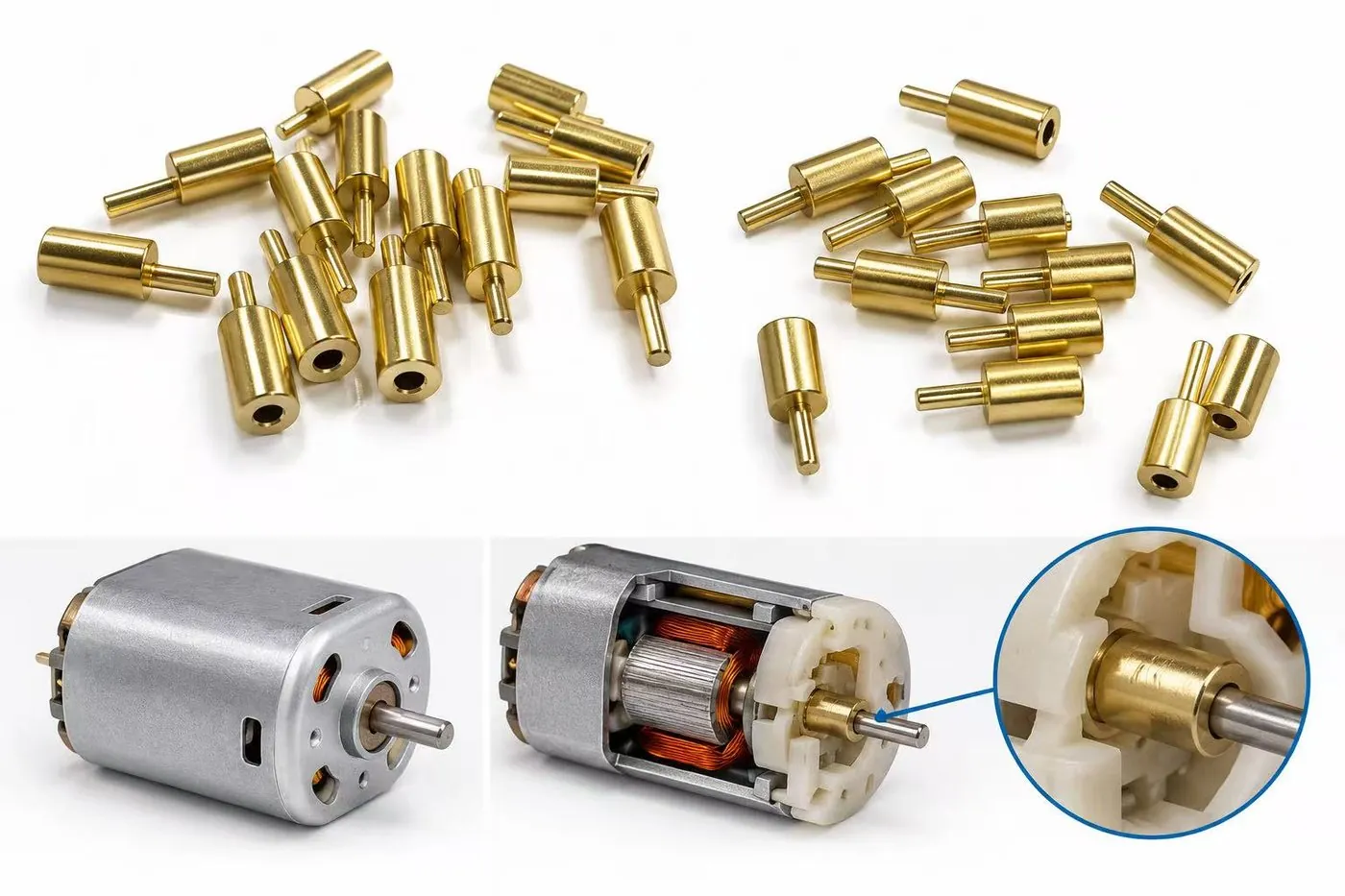
The part
Pressed onto a micro motor shaft, the offset mass converts rotation into vibration. If the centre of mass drifts, amplitude drifts with it — and the user feels it immediately.
Specification
These are the ranges we produce most often. If your drawing sits outside them, send it anyway — the answer will be honest, including when the answer is no.
| Material | Brass / carbon steel, plated |
| Shaft diameter | 1 – 3 mm |
| Overall length | 4 – 15 mm |
| Eccentricity | ±0.02 mm typical |
| Finish | Nickel or zinc, barrel plated |
| Process | Multi-station cold heading, eccentric formed in the die |
Values shown are typical for this part family, not a catalogue limit. Final specification is agreed against your drawing.
Why it is difficult
A part that looks correct can still fail in the field. These are the failure modes the process is designed around.
| Unbalance | Centre of mass off-axis shows up as noise and reduced amplitude at low speed. |
| Shaft fit | A bore that is 0.01 mm loose will spin on the shaft under load. |
| Mass variance | Batch-to-batch weight spread changes the feel between production runs. |
Inspection
Measured on the 2D projector against the drawing, per lot.
Weighed per batch — the cheapest proxy for correct geometry.
Pin gauge and press-fit trial on the customer shaft.
Plating coverage checked visually and by salt spray.
Where it goes
Coin and linear motors where the feel is the product.
Small motors with tight space and strict noise targets.
High-volume motors where cost per gram matters.
Feasibility, process route and an indicative price in 48 hours — including when the answer is that turning is the better route.
Send a drawing