Energy storage · battery modules
Anyone can make a 300 mm screw. Making one that goes through four stacked components without forcing is a different problem: straightness and thread run-out over the full length.
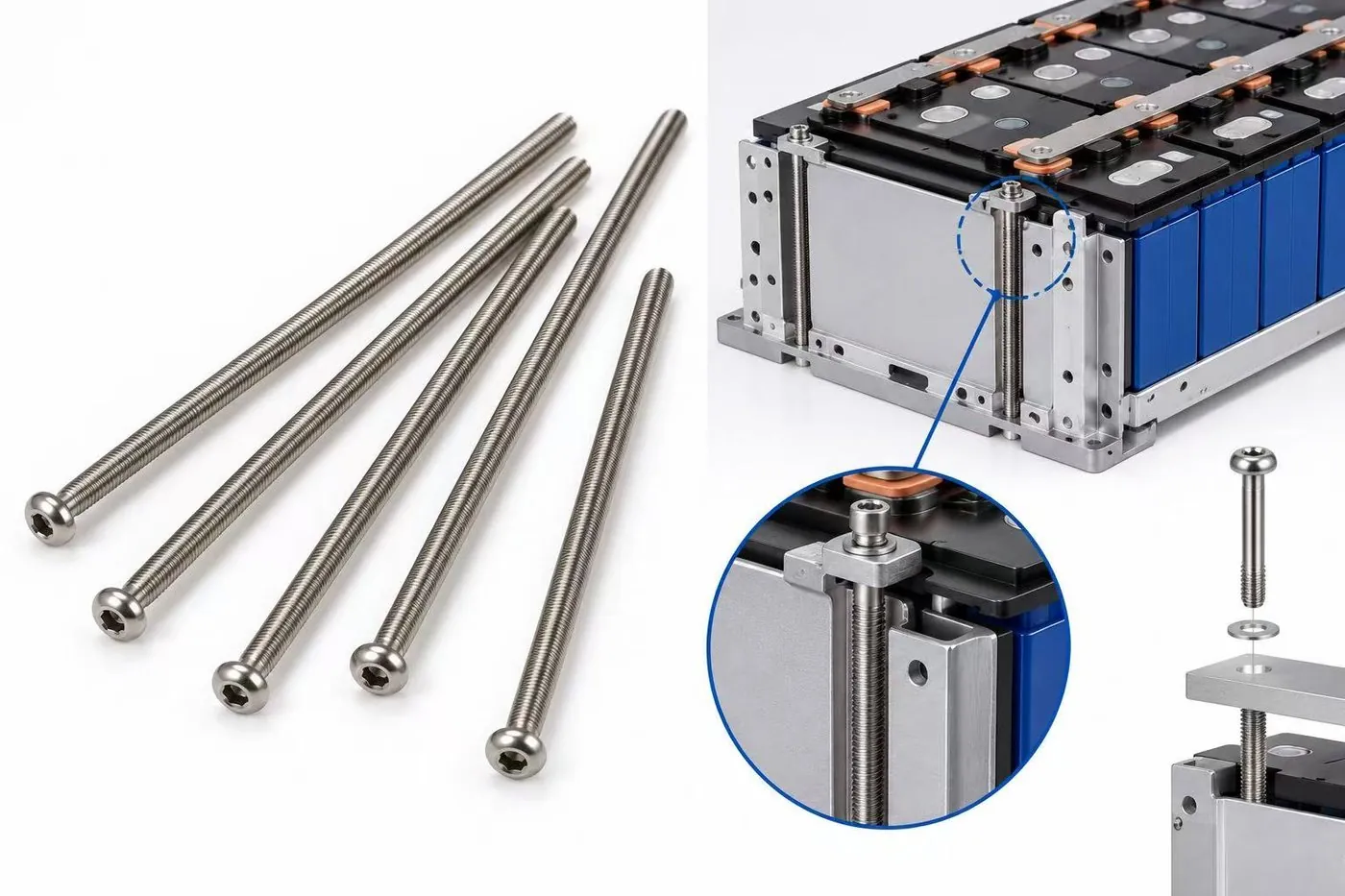
The part
Battery modules clamp prismatic cells between end plates with long screws. If the screw bows, the stack does not seat, and the assembler compensates with torque — which is where modules fail in the field.
Specification
These are the ranges we produce most often. If your drawing sits outside them, send it anyway — the answer will be honest, including when the answer is no.
| Material | Carbon steel · stainless steel |
| Thread | M4 – M8 |
| Length | 100 – 300 mm |
| Straightness | 0.3 mm per 100 mm typical |
| Finish | Zinc-nickel or plain, per pack requirement |
| Process | Cold heading + thread rolling + straightening check |
Values shown are typical for this part family, not a catalogue limit. Final specification is agreed against your drawing.
Why it is difficult
A part that looks correct can still fail in the field. These are the failure modes the process is designed around.
| Bow | A screw that is straight at both ends can still bow in the middle — measured over the full length. |
| Thread run-out | If the thread axis is offset, the nut cross-threads at the far end. |
| Thread length variance | Too long and it bottoms out; too short and it does not reach the torque spec. |
Inspection
Rolled on a surface plate, checked over the full length.
Measured against the screw axis on the projector.
Gauge check per lot.
Visual and torque test on the socket.
Where it goes
Clamping stacks of prismatic cells.
Long fasteners in energy storage cabinets.
Where a standard screw cannot reach.
Feasibility, process route and an indicative price in 48 hours — including when the answer is that turning is the better route.
Send a drawing